Off the Beaten Path | The Stand (1994)
It’s the middle of December, so it’s as good as any time for another Off the Beaten Path special. So what do I have in mind? Well, I’m dipping my toe into the world of literary miniseries adaptations with one of the few I’ve watched before. A miniseries that involves a world-ending plague – be forewarned, in the age of COVID, this could ring as too close to home – and the Biblical struggle to rebuild. If that alone hasn’t given it away (or, you know, the title of the post) I’m covering the 1994 ABC miniseries of the Stephen King tome The Stand.
So What is The Stand (1994)?
On the story side of things, this is a post-apocalyptic epic about the clash of good and evil.
On the Story Side

And when I say epic, I mean in scale and scope. The definitive version of the novel, an extended edition from 1990, clocks in at over 1,100 pages (my audiobook version on Audible is just shy of 48 hours long). So even though the miniseries is a distilled version of the novel, it is still stuffed to the brim with characters and story. For reference, the last show I covered on Off the Beaten Path with a character list close to this deep was V: The Original Miniseries and even that isn’t that close to what we get here. As such, I’ll address characters as they come along (please bear with me on this, it’s gonna be a long one).
The original novel is divided into three books, which the miniseries faithfully covers in four episodes. The first part of the story deals with the destruction of human society. On one fateful June night, a guard from a covert military base in the California desert flees from his post with his family. The reason? Inside the base, something got loose. Something that killed everyone inside. That something is Project Blue aka Captain Trips aka the superflu. What this guard, Campion is the name, doesn’t realize is that when he leaves the base he is taking Blue with him out into the world. And that’s the prologue.
The actual story starts when Campion crashes into a gas station in the little Texas village of Arnette four days later. By now his whole family is dead and he’s minutes away from death himself. Before the military can come in and contain Blue, Campion manages to infect everyone there. They in turn who begin the long chain that will result in the deaths of over 99% of humanity by the 4th of July. From here the episode largely follows 5 character plotlines that we follow throughout the story.
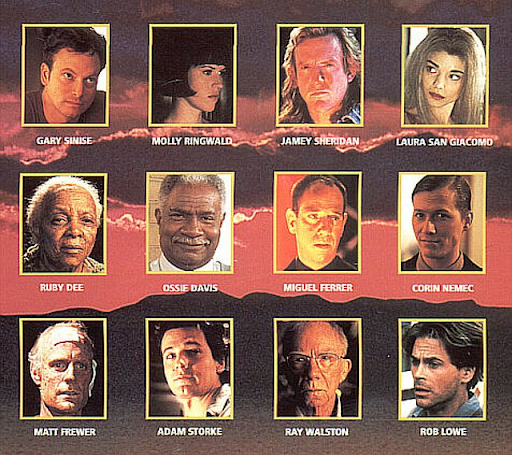
There’s Stu Redman (Gary Sinise). He’s one of the people present at the when Campion crashes into the gas station and in the end is the only survivor. There’s Frannie Goldsmith (Molly Ringwald). She’s a 21-year-old woman in Ogunquit, Maine who’s just discovered she’s pregnant and plagued by the affections of her best friend’s creepy 16-year-old brother Harold Lauder (Corin Nemec). There’s Larry Underwood (Adam Storke). He’s an up and coming musician fresh on the billboard charts, but when money problems start chasing him in California he returns to his childhood home in NYC. There’s Nick Andros (Rob Lowe). He’s a young deaf-mute drifter who gets jumped by local hoodlums in Shoyo Arkansas and tries to seek justice with the help of the local sheriff. All of them start having dreams of two people in particular. One is of a saintly old supercentenarian black woman named Mother Abagail (Ruby Dee) who lives on her family farm in Polk County, Nebraska. The other is of a man named Randall Flagg (Jamey Sheridan) aka the dark man aka the walkin’ dude aka many other epithets, a denim-clad demonic drifter with a penchant for sorcery and sadism.
By the beginning of July, America is in ruins. This is when the second part of the story begins. Here the bulk of the story follows the survivors as they begin finding each other with the idea of recreating society. Individuals find other individuals, and soon groups start finding other groups. Since everyone seems to be having the same dreams of either Mother Abagail or Flagg, people become drawn to them. Soon, two distinct societies start forming. One forms around Mother Abagail in Boulder Colorado dubbed the Free Zone. In the Free Zone, the people strive to live by the ideals of the old Republic by way of a town hall democracy. Another society, the Society of the People, forms around Flagg in Las Vegas. This society, a fascistic dictatorship ruled by Flagg himself, is managed through fear and quasi-religious awe.
Compared to part one, not as many characters get introduced here. That said, there are a couple that bears noting. We meet Glen Bateman (Ray Walston). He’s a talkative sociology professor in New England who joins up with the nascent group of Frannie, Harold, and Stu. There’s Tom Cullen (Bill Fagerbakke). He’s a kind-hearted yet mildly retarded Oklahoman who is the first to join Nick in his journey across the country. There’s Ralph Brentner (Peter Van Norden). He’s an Oklahoma handy-man/all-around good guy who runs into Nick and Tom on the road. There’s Nadine Cross (Laura San Giacomo). She’s another survivor of NYC who joins Larry but hides a dark secret. There’s Lloyd Henreid (Miguel Ferrer). He’s a small-time crook who was arrested at the end of a multistate kill spree just before the superflu. Flagg saves him from starvation in prison and makes him his right-hand man. Lastly, there’s the Trashcan Man (Matt Frewer). He’s a psychotic pyromaniac who becomes fanatically devoted to Flagg when Flagg promises him he could burn down the whole country.
The third and final part of The Stand is the titular stand between good and evil. It starts when Flagg directs a partly successful assassination attempt against the Free Zone leadership. Mother Abagail, sensing her time is near, gives some of the leadership – Larry, Stu, Glenn, Ralph – one mission from God. That mission? To walk from Boulder to Las Vegas to make a stand against Flagg’s forces of evil. As they march, Flagg’s leadership is challenged by internal and external forces. Safe to say, the final stand is a true reckoning of good vs. evil.
On the Production Side
Ok, so I’ve finally covered the largely spoiler-free bullet points of the story and characters of The Stand. Now it’s time I give some mentions about the production side.

First, I bet some of you are wondering about the history of The Stand. It was King’s fourth published novel, his follow-up to The Shining. It was first published in 1978, then again with an extended edition (closer to a restoration of his original manuscript than a second draft) in 1990. Since its release, The Stand has become one of King’s most seminal and popular works. It introduces the character of Randall Flagg, a recurring villain who featured prominently as one of the main villains in King’s The Dark Tower series (If you’ve watched the 2017 movie The Dark Tower, Matthew McConaughey’s character is Randall Flagg under a different name). It, along with It, is also a good intro to King’s works, flaws and all.
It should come as no surprise then that there were many attempts to bring The Stand to the screen. As early as 1980, King was involved in many attempts to adapt the novels, oftentimes writing the screenplays himself. The first was a feature adaptation planned with George Romero. This fell through as the years passed due to the poor box office performance of movies based on King’s books, along with difficulty finding a studio willing to release multiple movies.
It wasn’t until Pet Semetary became a box office success that Hollywood pushed forward with adapting the novel. After the success of the 1990 It miniseries, ABC accepted King’s pitch for a 4 part miniseries. King himself ended up writing a 420-page screenplay for the series, and ABC tapped Mick Garris to direct. The duo were then given $26 million to create their vision by the execs at ABC.
After a relatively smooth production, the miniseries aired on ABC in May of 1994 aka at the height of sweeps month. Each episode managed to get around 19 million viewers, making it a ratings success.
So Why The Stand (1994)?
Now, at long last, I get to talk about why I wanted to review The Stand (1994). There are a few reasons.

The most immediate reason is that CBS All Access is releasing a 9 part miniseries adaptation of The Stand on December 17. Since I learned about the release date back in the summer, I had planned on having one December review be The Stand (1994). At the time, the other review I had in mind was the Syfy miniseries Frank Herbert’s Dune to coincide with the release of Denis Villeneuve’s upcoming Dune. While Dune has been moved to October 2021, I figured why not keep to my plan to review The Stand (1994) before reviewing The Stand (2020) (I’ll cover that on Watercooler Reviews).
The bigger reason is that I’ve been a Stephen King fan for most of my life. I read my first King novel, The Shining if you’re curious, at the precocious age of 11. Since then I’ve read many of King’s earlier works, including The Stand. While my interest has waxed and waned over the years – I’m largely unfamiliar with any of King’s works after Under the Dome for this reason – his tales of horror have always been foundational in my interest in the genre.
Since I’ve moved to Chicago, some of my favorites by King – The Shining, ‘Salem’s Lot, The Stand, and The Gunslinger specifically – have been in my regular Audible rotation. Back during the early days of the COVID-19 pandemic (as in the last week of March), I attempted to re-listen to The Stand because I tend to deal with stress by inundating myself in reminders of said stress. Safe to say, I didn’t get past the collapse of society (I ended up listening to The Shining and Doctor Sleep later in May, which I mentioned in my review of Crashing).
Plus, I had watched The Stand (1994) once before, back in high school. While I couldn’t give you exact details of my thoughts on the miniseries – this would have been around a decade ago now – I do remember that I thought it was a cheap-looking adaptation that skipped over some of the more interesting parts of the novel while making odd casting choices. Now, a decade later, I’m interested to see if this opinion will shift. I now recognize much of the main cast members, plus now I know King himself wrote the script for the miniseries.
So, you know, it’ll be fun revisiting this King classic in tv form.
My Thoughts on The Stand (1994)
So, after rewatching the miniseries, I’ve come to one conclusion. Namely, while it’s not exactly bad television, I think the miniseries struggles under the weight of trying to convey all the story in the original novel.
Just as a side note before I proceed. Due to how much the novel has stuck with me over the years – doesn’t hurt that I also re-listened to the audiobook over the last week in prep – this review will end up being about whether or not The Stand (1994) is a good adaptation. That might seem unfair to the miniseries (there’s a reason people tend to say “the book is better” after all), but to be honest I’m not sure I can disentangle the two. As such, I’ll try my best to judge The Stand (1994) on its own merits instead of just going “the book did it better”.
Some good things
Before I leap into what about The Stand (1994) rubs me the wrong way, I’d be remiss if I didn’t mention some positives.
First and foremost, Mick Garrison’s directing isn’t bad. It’s not to the level of modern day TV directing, but nothing from that time is. Out of the older tv shows I’ve watched, especially those I’ve watched for Off the Beaten Path, The Stand (1994) is up near the top. The only one that compares really is V: The Original Miniseries. If there’s a complaint I have with it, it’s that it feels dated in form and presentation. That said, it’s not the kind of dated the annoys me, and for the most part I’m able to look past it.
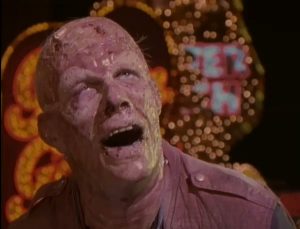
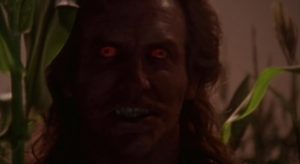
If there is a real highlight of the series though, it’s in the production values. There’s a reason the show won an Emmy for makeup. While the transformation sequences from Flagg’s human form to his demonic form are rather dumb looking, the actual make-up works rather well all things considered. With Trashy, the process of turning him into a normal looking dude to radiation scarred wretch is done all through make-up, and is one of the things that’ll be tough for The Stand (2020) to top. Lastly, while my doctor family members definitely question the make-up of the plague victims, it’s fair to say the make-up department did a good job making the sick look really sick. Again, if I have any complaints here, it’s the dated look, but I can also overlook that.
The story struggles of adapting such a sprawling narrative
If you look back about 1,000 words ago, you’ll see I said that the restored edition of The Stand is over 1,100 words long. Because of this immense length, there’s little chance The Stand could ever be adapted into a movie satisfactorily. Going into The Stand (1994), I figured four episodes with a combined runtime of 6 hours could suffice; 1 episode for the destruction of society by Captain Trips, 2 episodes for the survivors to wander the land and regroup, and 1 episode for the titular stand between good and evil.
Before I was even done with the miniseries, I realized this wasn’t the case. I’ll give King credit though, the miniseries is incredibly faithful to the book. Details and the sequence of events may differ. On the whole, the story is transposed to the screen without much deviation, flaws and all. So if you’re more often concerned with a show/movie staying faithful to the source material, you’ll mostly be please here.
Many of the changes are understandable to me from a standards view. As a show made for broadcast tv, there’s no way in hell some of the more vivid moments could be shown on TV as described in the book. Stuff like the kangaroo court and executions broadcast from Portland Maine, or the second Kent State Massacre during the fall of society, or the whole episode about “The Zoo” (it’s a nomadic rape gang Stu’s group comes across and wipe out, helping liberate Susan Stern and Dana Jergins in the process), or even some of the more gory moments like the extent of Lloyd and Poke’s initial gas station robbery wouldn’t fly on ABC now, yet alone 1994. And those are just a couple of examples. Changes like that aren’t what bothers me about this adaptation.
The problem is that in trying to faithfully adapt his novel as best he can, King ended up creating a story where everything feels a tad rushed at best and undermines some characterization for the sake of expediency at worst.
The rushing I can kinda understand. The story, full of side tangents and meandering journeys of self-discovery and self-destruction, doesn’t need to be adapted beat-by-beat to be successful. There’s plenty of room to condense the story in fact. That said, some of the stuff King rushes made me yell at the screen “Calm down Stephen! Take your goddamn time for once!”. While this struck both sides of the protagonist-antagonist divide – the escalation of the dreams about Mother Abagail and the formations of both societies are rife with this – the biggest gripe I had about this pace was about Flagg’s set-up.
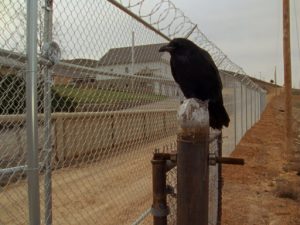
From the immediate get-go, Flagg’s presence and influence are made clear. There’s a crow (one of the main animals he’s associated with) at the military base when the superflu is accidentally released. Later, when Campion crashes in Arnette, he mentions being chased across the country by “the dark man”. There’s more, but taken together it creates the impression Flagg was personally behind the superflu’s release. And that’s all within the first 10 minutes.
While Flagg is certainly evil enough to do that, I feel it undermines both his character compared to the book and some of the broader themes of mankind’s capacity for mutual self-destruction that dominated the Cold War. It turns him from an ageless evil born for the right moment akin to the cult leaders and terrorists that inspired the character to a more typical evil overlord. Plus, how quickly he’s revealed to be an overpowered sorcerer from the get-go instead of a man who discovers his powers as his influence grows makes me wonder why he doesn’t use those powers to wipe out the Free Zoners before they know what hits them as he did to Kareem Abdul-Jabar’s monster shouter. But even if King wanted to shift to this kind of characterization, he could have done so without clobbering us over the head with it. In a way, it’s this narrative clobbering that rubbed me the wrong way when it comes to the rushed story set-up.
But that’s just one example of a character getting rushed and a pretty unique one at that. What’s more common is that certain scenes or turning points happen offscreen. For something this faithful to the novel’s narrative, this is inevitable. If we go by the novel there are at minimum 10 characters that go through distinct arcs, and those are just the ones who have multiple chapters told from their POV. That’s a ton of ground to cover for anything, let alone a 4 episode miniseries. That said it can still hamper the narrative noticeably.
This is present in all the narratives to a degree. For example, Stu and Frannie’s relationship doesn’t get much in the way of build-up, Harold’s growing insanity is slapdash, etc. The ones who get the shortest shrift are the characters primarily around Larry’s orbit. For Larry himself, we never really see him hit the rock bottom that helps him grow as a character. In the book, he arrives in New York not only in money trouble with a drug dealer but also strung out after a weeks-long drug bender. When he leaves New York with an older socialite name Rita Blakemoore, he confronts his worst traits after she commits suicide because she couldn’t handle the post-plague world with him. Near delirious from self-loathing and exhaustion, he begins the turnaround when he runs into Nadine and a young feral boy named Joe. From there, he begins the process of growing into a responsible man and a respected leader amongst the survivors.
In the miniseries, we never really see him hit rock bottom. He starts off as a narcissistic man-child sure, but we never see him reach the depths of despair he plumbs or see the moments that change him. We never see him struggle with his past life as a taker and “bein’ no nice guy” on his own. We don’t see that breakthrough with Joe when Larry plays the guitar. We get none of that. All we get is the before and after picture.
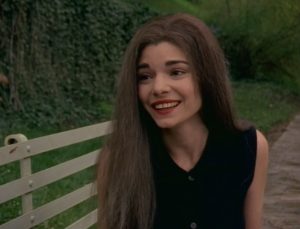
If anyone is hit by this narrative rushing the hardest though, it’s Nadine. In the novel, she was the first caretaker of Joe, and when she joins up with Larry in New Hampshire they become surrogate parents of a sort. Soon, the dreams of Flagg, the one she is promised for, in conjunction with Joe’s lessening dependence on her and Larry becoming an item with Lucy Swann cause her to fall. By the time she works with Harold to assassinate the Free Zone Committee, there’s a sense of deep tragedy in her fall.
In the miniseries, she’s combined with a character named Rita Blakemore, the woman Larry leaves NYC with. So instead of dealing with Rita’s death, Larry only deals with Nadine randomly leaving (this bit also goes back to rushing Flagg). It’s a change that makes sense on paper, but in effect, it removes the sense of tragedy around her fall. When she tries to seduce Larry before succumbing to her destiny as Flagg’s virginal bride, there should be a sense of tragedy. In the miniseries, the scene is there but it feels performative, like it’s there to facilitate the plot instead of a logical consequence of intertwined character arcs. It just feels empty, which is itself tragic.
If I had to attribute a reason for this beyond the sheer length of the novel, I’d put it down to King’s writing style. If you have never read a King novel, he relies on inner dialogue to facilitate character and story. Many chapters in the book go through a cycle of real-time actions split up by inner dialogue and extensive flashbacks. Safe to say, most of that isn’t exactly filmmable. This isn’t even limited to The Stand. To me at least, it’s the biggest challenge any filmmaker has with adapting something by King.
That in itself is fine, it’s one of the defining and unique aspects of a prose narrative. The issue is that King didn’t have enough time to communicate that inner dialogue through onscreen action. He could have gotten around that by either asking ABC for another episode or two or had gotten more creative and changed around the narrative while sacrificing faithfulness to the book. Unfortunately, he did neither, so we’re left with a narrative so distilled it sags under its own weight like a soggy balsa wood bridge.
What about that massive cast list I mentioned earlier?
Alright, so after that long rant about the plot of the miniseries and the characters that populate it, we can agree that they are thinly drawn at best due to the limitations of the medium. But what about the actors playing those characters? Like the plot, it’s both rosy and muddied.

On the one hand, we got some good performances. On the protagonist side of the cast list, my favorite performances were Gary Sinese’s (Stu), Ruby Dee’s (Mother Abagail), and Bill Fagerbakke’s (Tom Cullen). All three not only capture the spirit of what makes the characters tick in the book but inject some onscreen pathos that helps endear us to the characters. Sinese and Dee weren’t super surprising to me in this regard. Going in it felt like they were perfectly cast for their roles, and after watching them I wasn’t wrong in that assessment. Fagerbakke was a pleasant surprise, bringing that childlike good nature to good ol’ Tom Cullen. It’s honestly no surprise Fagerbakke, later on, became the voice of Patrick Star.
On the antagonist side, my favorites performances were Jamey Sheridan’s (Flagg) and Matt Frewer’s (the Trashcan Man). With Sheridan, he brought that jovial yet megalomaniacal energy I would expect. Even before he shifted into his more demonic forms, I could see Sheridan as a bestial presence akin to, well, the Beast from Beauty and the Beast. As for the Trashcan Man, Frewer brings a different kind of psychotic energy to the role. A twitchy spaz with a love of fire and explosives who becomes more and more wretched as time goes by. Between the two, it was Frewer who was the real surprise.

Lastly, if I’m going to talk about the good performances of the show, I should mention some of the cameos and bit roles that pepper the story. If I had to pick three off the top of my head, I’d go with the following. There’s Ed Harris, who plays General Starkey, the general in charge of Project Blue. There’s Kathy Bates, who plays Rae Flowers, the radio DJ shot on-air by some military goons for reporting on the pandemic. Lastly, there’s Kareem Abdul-Jabar, who plays the monster shouter in NYC. All three are some combo of perfectly cast (moreso in Harris’ case) or highly memorable (moreso Bates and Abdul-Jabbar). Sure, they’re all in The Plague, but that’s the one that features the most varied characters anyway.
But as I mentioned earlier not all the casting and performances were great. For the most part, these fall on the side of not bad but not great either. Performances like Rob Lowe as Nick Andros, Laura San Giacomo as Nadine, Ray Walston as Glen Bateman, and Miguel Ferrer as Lloyd Henreid were serviceable, but not overly spectacular.
Then there were these performances, which left me scratching my head. The first was Molly Ringwald as Frannie Goldsmith. While I won’t go as far as saying she was miscast, but I wasn’t a big fan of her performance. It just felt stilted and emotional at the wrong times. Then again, I’ve never been crazy about Ringwald as an actress, so maybe I’m biased.
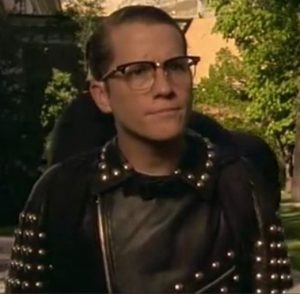
The one role I’d call entirely miscast was Corin Nemec as Harold Lauder. In the book, Lauder is a fat bookish nerd, a perennial second favorite, and a loser who can’t let go of his past grievances. He’s basically King as a teenager if he was a proto-incel. Nemec is not that. He doesn’t look like the kind of guy who got bullied in school. If anything he looks like a jock that was made a nerd by the costuming department by slapping some glasses and a few fake pimples on his face. Hell, he looks older than Ringwald, who’s supposed to be 5 years older than him in-story. It’s baffling really.
I’ll end my talks about the casting (and my general thoughts about the miniseries as a whole) with this. If there’s anything about The Stand (2020) that has me intrigued, it’s the casting. Here’s hoping the roles that were played well in The Stand (1994) are also played well while those that didn’t get their chance to shine get that chance this time around.
My Thoughts on the Episodes
Episode One: The Plague

Out of the four episodes we get, I think The Plague is my favorite. Why, you might ask? A few reasons. In regards to what I’ve talked about before, I think this is because The Plague suffers the least from the process of adapting the story of the novel to the screen.
Why is this? I think it’s because this section of the story, both in the book and in the miniseries, is fairly independent from the rest of the greater narrative compared to the other parts. Besides the main POV characters who show up, most of the characters who populate this stretch of the story die while the side characters who help define the story won’t show up until part II/The Dreams. As such, any changes that happen here don’t tend to ripple out, which also frees the narrative to make some changes.
And those changes aren’t bad. They help flesh out a world collapsing from the joint attacks of a virus and the heavy-handed tactics used to contain it. Sure, it isn’t as stark as in the book – the chapter of the book that focuses on vignettes of the collapsing society going insane has some of the most vivid passages I’ve ever read – but since this is made for broadcast TV I’m not surprised it was toned down.
Lastly, the fact the episode is bookended by Stu Redman is a plus since Sinese is consistently one of the best performers on the show. In between, we also get some of the more memorable cameo roles of the miniseries, which is also a plus.
If I have any major complaint about The Plague, it’s how hard King pushes some ideas and foreshadowing. In particular, how much he pushes Flagg and the dreams of Mother Abagail. Even without the book in mind it just feels so heavy-handed. Lucky, it doesn’t sink The Plague, which is itself a solid foundation for the miniseries to build on.
My Recommendation: Recommend
Episode Two: The Dreams

The Dreams is in a tough spot. As the first part of Act II of the narrative, its primary concern is introducing the survivors who slowly glom together in their quests to get past the horrors of the last few weeks and piece their lives back together. In terms of being faithful to the novel, the major beats are all there. Plus, the endpoint I imagined would make a good endpoint, the arrival of Nick’s party and Mother Abagail in Boulder to establish the Free Zone, is the one that’s used. So why is The Dreams in a tough spot?
As I’ve mentioned earlier, the issue here is that there’s so much that needs to be covered within the limited runtime that the story starts to feel rushed. For example, we get through nearly the entire episode before Stu and Glenn (who needs an introductory scene of his own) join up with Fran and Harold. For something more general, the story has become overly streamlined. In the book, people tend to wander around the countryside until the sheer weirdness of the dreams prompts them to go to either Hemingford Home or Las Vegas. Here, everyone narratively sprints towards either place. It creates the feeling events are happening because the narrative demands they happen instead of natural character choice.
This is also the first episode where the missing scenes I talked about start making themselves felt. With Larry, he’s left by Nadine somewhere in Pennsylvania. The next time we see him, he’s outside Des Moines, looking none the worse. With Trashcan Man, he’s declaring “my life for you” before he blows up those first oil derricks (which itself feels premature since he hears Flagg’s voice once before making this declaration), then besides one quick shot of him wandering through the Utah desert, he’s in Vegas.
Compared to the other episodes, The Dreams is still one of the better ones. That said, the narrative sag is starting to be noticed. If only King could have gotten another episode or two, set between this and The Betrayal, then my complaints would be lesser.
My Recommendation: Recommend with Caveats
Episode Three: The Betrayal

Like in the book, The Betrayal is when the story begins to stall. When writing the book, King had a wicked case of writer’s block, prompting him to abandon the manuscript for many months. The issue? Once the protagonists reached the Boulder Free Zone and began re-establishing society, the grander conflict fell out of focus. The protagonists, now largely comprising the Free Zone Committee, have started flirting with the old ways of society that led to their original downfall. The solution? Harold blows them up with a bomb. Here, the story stalls as well, but it’s more noticeable.
Out of the four episodes, The Betrayal is the one that suffers the most from the lack of King’s trademark inner dialogue. This is particularly apparent when the show covers Harold’s descent into darkness. In the novel, we get a look into Harold’s sickening mind during his POV chapters. There we see a boy unable to let go of his past grievances even when presented with an opportunity to become a new man. When Fran chooses Stu over him, we see Harold take this as confirmation that the old social order, the one that laughed at him and treated him like dirt (the thought never occurs to him to try and better himself or reach out) was still breathing. This, combined with the rage at being denied a seat on the Free Zone Committee like he thought he was owed, makes him a prime target for manipulation by Nadine and Flagg.
Here, it’s just a few scenes and dirty looks. He has one dream and decides it’s time to blow up the Committee. Combined with the massive miscast of Harold, and it loses that punch of the novel.
What’s more, this episode feels downright soapy. Since it takes until this episode for Stu and Fran to get together and for Nadine and Larry to reunite, the drama of the episode is locked up in two love-dodecahedrons. This might not have been an issue if those missing scenes I’ve harped on were all there. It could have given weight to the tangled web of romantic drama, but without those scenes, it all feels performative. Again it’s like they’re there because the narrative demands they are there instead of through organic character choice.
Lastly, it hurts the quality when Fran and Harold are more dominant in The Betrayal, which means we get more of their lackluster performances.
My Recommendation: Recommend with Caveats
Episode Four: The Stand

The last episode of the bunch, The Stand is left in a bit of a lurch. Moreso than the others. This is something I put down to the weaknesses of the novel. Namely, the ending in the novel is rather weak. As such, this is largely what I’ll be focusing on here.
If you’ve ever read a King novel (or just gathered this through pop-culture osmosis), you’ll know that King tends to write weak endings. His writing style is highly character-centric; he creates some characters, puts them in a wild situation, and then improvs from there. He rarely plans out a story beyond Act I, instead letting the choices the characters would make define the progression of the story. Sometimes this works out, other times it doesn’t. When it doesn’t it usually involves a solution seemingly whipped up out of thin air. Plus, this tends to get magnified the longer the work is.
In the case of all renditions of The Stand so far, this ends with a literal deus ex machina. After leaving Stu behind due to a broken leg, Glenn, Larry, and Ralph make it to Vegas. Glenn is killed in captivity while Larry and Ralph are set to be executed in front of the entire Society of the People. Then, Flagg kills a dissenter with some conjured ball lightning, Trashy shows up with a nuke, and the ball lightning becomes a literal “hand of God ” that detonates the nuke. It’s a weak ending that relies on protagonist passivity. In the novel, this is easier to ignore, since up till this point the characters are compelling enough to appreciate the journey they embark on rather than focusing on where they end up. Here in the miniseries, where the characters are much more thinly drawn, that cushion is absent, making the ending stick out even more. Plus, the special effects they use make the whole scene look downright goofy.
So yeah, The Stand is a weak ending to a weak miniseries. There’s some good stuff in there, but not enough to off-set the famously weak ending of the novel.
My Recommendation: Recommend with Caveats
In Conclusion
So that’s The Stand (1994) in all its flawed glory. It’s a noble attempt by King himself to adapt his mammoth novel, to be sure, with good performances and decent ideas to streamline everything. It’s just there’s just so much story involved that the miniseries, with only four episodes, can’t cover everything satisfactorily while remaining as faithful to the novel as it is. As of now, I’d only recommend The Stand (1994) to either big fans on the novel, King completionists, or people curious about how it might compare to The Stand (2020). Speaking of The Stand (2020), here’s hoping it fares somewhat better than The Stand (1994). Otherwise, I’d just stick to reading the novel.
In Case You’re Interested in The Stand (1994)
If you’re interested in streaming The Stand (1994), you can find it on YouTube. If you want something with better quality, you can rent it on Amazon.